
When I bought Malvern Town Football Club in 2012, I thought I was buying a football club. What I had not fully considered was that I was also taking on a bar and all the operational realities that come with it.
In the early days, the bar felt secondary. Staffing, stock control, tills, licensing and breakages competed with what I believed was the real focus: football. Building a team, improving facilities and progressing on the pitch.
Over time, the reality became clear. For non-league football clubs and community venues, the bar is critical to long-term sustainability. The revenue generated behind the bar funds investment on and off the pitch. Without it, progress stalls.
The Reality of Hospitality Today
Running a bar has never been tougher. Energy bills are punishing. Staffing is fragile. Margins are extremely tight. Every pound must work harder than it used to.
When you add the cost of live sport broadcasting, many venues question whether showing sport is worth the effort.
Alongside my role in AV and control systems at HDA, I live the hospitality reality every week. I do not theorise about venues. I run one. I see where technology supports the business and where it creates stress.
In a town the size of Malvern, only two venues consistently show live sport. That alone highlights how much the landscape has changed.
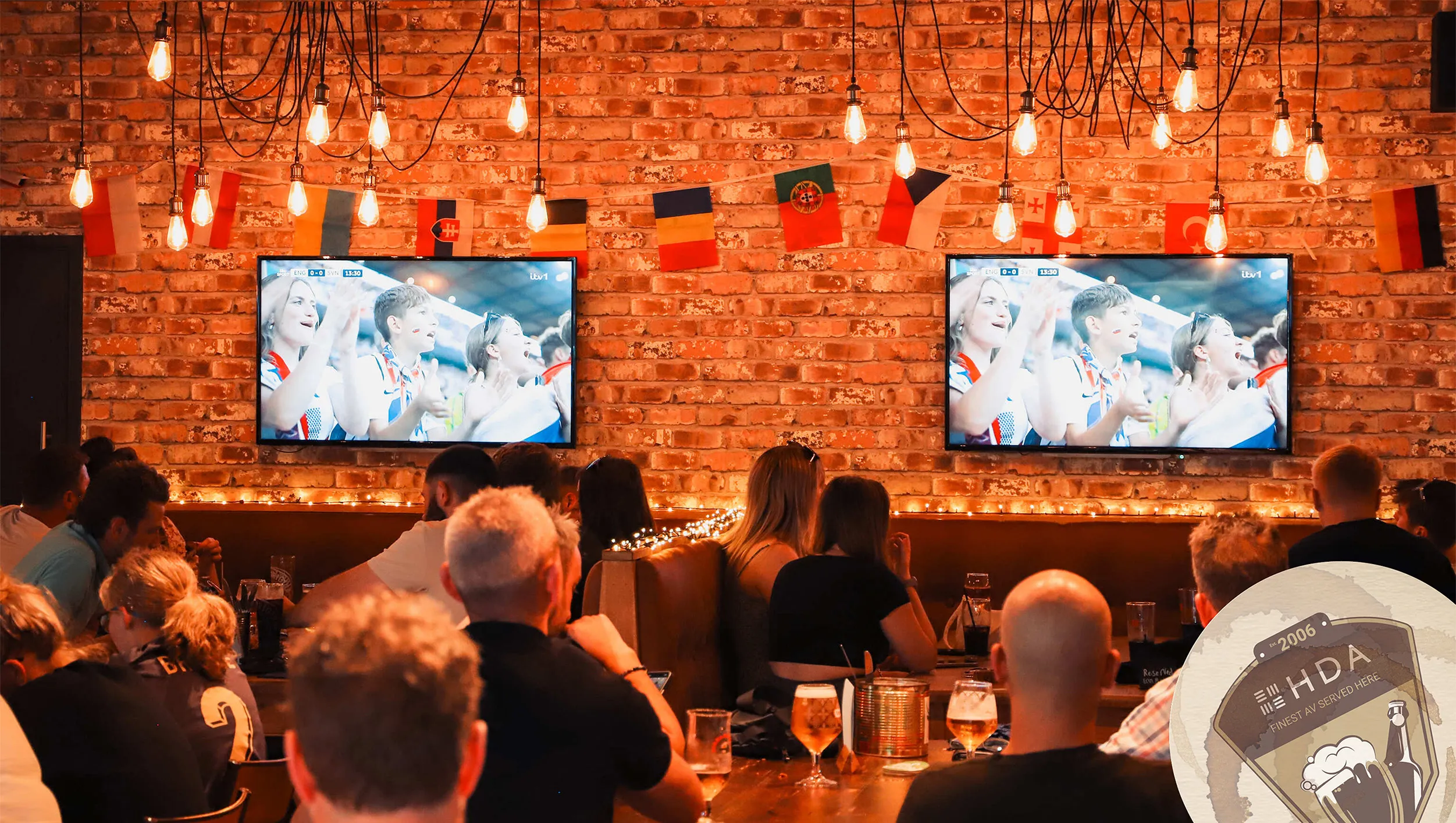
Reliability is the difference between a busy matchday and a lost opportunity.
Cost and Stress Drive Decisions
From my perspective, there are two main reasons venues remove screens.
The first is cost. If displays are treated as basic televisions, the return quickly feels marginal.
The second is stress. Live sport exposes weaknesses in AV systems. Incorrect sources, missing audio, displays failing to power on. When that happens just before kick-off, atmosphere disappears and takings follow.
Many operators remove screens because of poor experiences, not because live sport lacks value.
When AV Is Reliable, Results Follow
Venues that deliver live sport effectively benefit from longer dwell times, higher spend and increased footfall during major fixtures. Live sport contributes over a billion pounds annually to UK pub revenue. That income supports wages, rent and long-term survival.
At Malvern Town Football Club, we see this first-hand. Our clubhouse uses professional video distribution rather than standalone displays. The AV system exists for one reason: to keep people in the building longer and encourage them to return.
This approach aligns with how HDA supports commercial AV and hospitality environments.
Screens are Buisness Tools
One of the biggest misconceptions in hospitality is that screens only justify themselves during live sport.
Screens can promote events, reinforce identity and support day-to-day trading. We recently launched our own beer, Langland Lager. Promoting it on our screens before launch led to it selling out on day one. That outcome came from better use of existing displays, not complex marketing.
Digital signage is no longer complex or expensive. Players are affordable. Content scheduling is straightforward. Control can be automated using platforms like uControl, designed to simplify AV operation in real-world environments.
Simplicity Is Everything
Owning a bar has reshaped how I view AV control.
Staff turnover is expected. Training time is limited. Systems that rely on memory or confidence eventually fail. What staff need is certainty.
Fixed actions. Clear outcomes. One press to turn everything on. One press to select live sport. One press to shut down at closing time.
That philosophy underpins how HDA specifies and supplies HDMI matrix switching and video distribution hardware, including solutions like MHUB S, available through the HDA Store.
Creating Opportunity, Not Stress
Removing screens entirely feels like a step backwards. Not because sport is mandatory, but because flexible, reliable AV gives venues options. From matchdays to quiz nights, private events, promotions and everyday atmosphere.
I have real empathy for operators navigating today’s pressures. Margins are thin and patience is limited.
The answer is not less ambition. It is better tools.
When AV works quietly and reliably, screens stop being a problem. They become an advantage.
